

Is a PTH level of 40 pg/mL normal? The answer depends on the patient's serum calcium level and the clinical context.
In a patient with hypercalcemia, a PTH level within the reference range may indicate an inadequate response, since suppression of hormone secretion would be expected, depending on the course of the condition. In a patient with hypocalcemia, on the other hand, the interpretation depends on whether the parathyroid gland is responding appropriately to the decrease in circulating calcium.
Therefore, the evaluation of calcium metabolism disorders should not be based solely on parathyroid hormone (PTH) levels. Interpretation depends on the relationship between PTH and calcium concentration, while also taking into account other laboratory and clinical findings.
In this article, you will learn how the body regulates calcium, when to order a PTH test, and how to interpret the results when investigating mineral metabolism disorders in dogs and cats.
How does the body regulate calcium?
Calcium plays a role in essential functions such as muscle contraction, neuromuscular transmission, blood clotting, hormone secretion, and bone metabolism. For these functions to occur properly, its concentration in the body must be maintained within narrow physiological limits.
This regulation involves the coordinated action of parathyroid hormone (PTH), vitamin D, the kidneys, the intestines, and bone tissue.
One of the main mechanisms of this regulation is the calcium-sensitive receptor (CaSR), which is present in parathyroid cells. It detects changes in the concentration of ionized calcium and plays a role in regulating PTH secretion.
The physiological response is:
- Low ionized calcium: stimulates PTH secretion.
- Ionized calcium within the physiological range: hormone secretion adjusted to the body’s needs.
- High ionized calcium: suppression of PTH secretion.
This relationship explains why the same PTH concentration can have different meanings depending on serum calcium levels.
What are the functions of PTH and vitamin D?
PTH is one of the main regulators of calcium and phosphorus metabolism. Its effects involve various organs and systems.
In the bones, PTH stimulates mineral mobilization by regulating bone remodeling, thereby promoting the release of calcium into the bloodstream.
In the kidneys, it increases tubular reabsorption of calcium and reduces reabsorption of phosphorus. It also stimulates the activity of the enzyme responsible for converting 25-hydroxyvitamin D into 1,25-dihydroxyvitamin D, or calcitriol.
In the intestine, PTH’s effect on calcium absorption occurs primarily indirectly, by increasing the availability of active vitamin D.
Vitamin D plays a role in the intestinal absorption of calcium and phosphorus and in maintaining mineral homeostasis.
Other components may also contribute to the investigation of calcium disorders. Parathyroid hormone-related peptide (PTHrP), for example, is associated with certain causes of hypercalcemia, particularly hypercalcemia related to neoplasms. Calcitonin, on the other hand, plays a role in regulating bone metabolism, although it has more limited diagnostic applications in routine veterinary practice.
Ready to evaluate your patient's calcium metabolism?
When should you order a PTH test for dogs and cats?
PTH testing aids in the evaluation of abnormalities in calcium metabolism and should be interpreted in conjunction with the patient's clinical and laboratory data.
Among the main indications are:
- Investigation of persistent hypercalcemia.
- Investigation of hypocalcemia.
- Suspected primary hyperparathyroidism.
- Suspected secondary hyperparathyroidism, especially in patients with chronic kidney disease or nutritional disorders.
- Suspected hypoparathyroidism.
- Assessment of Mineral Metabolism in Patients with Kidney Disease.
- Integrated research on changes in calcium and phosphorus.
The choice of additional tests depends on the abnormality identified and the diagnostic hypotheses. In addition to PTH, it may be relevant to measure total or ionized calcium and phosphorus, assess renal function, and evaluate vitamin D metabolism.
How should PTH be interpreted in conjunction with calcium?
Integrated interpretation makes it possible to assess whether the hormonal response is consistent with the observed calcium concentration.
Hypercalcemia with elevated or inappropriately normal PTH levels
When ionized calcium levels rise, PTH secretion is expected to decrease. Therefore, elevated or inadequately suppressed PTH levels may suggest a PTH-dependent cause, such as primary hyperparathyroidism.
The Inappropriately normal PTH warrants attention, since the result may fall within the method’s reference range but may not represent an adequate physiological response to hypercalcemia.
In this situation, the PTH should not be interpreted based solely on the numerical result. It is necessary to consider the calcium concentration, the calcium species, the method used, and the other findings from the investigation.
Hypercalcemia with Suppressed PTH
When hypercalcemia is associated with PTH suppression, the evaluation should prioritize causes that are not related to excessive secretion of this hormone.
Differential diagnoses include hypercalcemia associated with neoplasms, vitamin D intoxication, and certain granulomatous diseases. In dogs and cats, other causes should also be considered depending on the clinical context.
Hypocalcemia with elevated PTH
Given the decrease in ionized calcium, an increase in PTH secretion is expected. Therefore, elevated PTH levels may represent an appropriate compensatory response.
The investigation should identify the cause of hypocalcemia and assess whether there are any associated conditions, such as kidney disease, vitamin D deficiency, nutritional issues, or disorders that impair calcium absorption or availability.
The presence of elevated PTH, on its own, does not determine the cause of the abnormality.
Hypocalcemia with low or inappropriately normal PTH levels
When ionized calcium is low but PTH does not show the expected increase, an inadequate parathyroid response should be considered.
This pattern may be consistent with hypoparathyroidism, including acquired forms or those associated with previous interventions, but it must be interpreted in conjunction with the other results.
Phosphorus levels, kidney function, medical history, and other laboratory data help distinguish between possible causes.
In all of these scenarios, the interpretation should take into account the method's reference ranges and the specific characteristics of dogs and cats.
What is the significance of ionized calcium and total calcium?
Circulating calcium consists of different fractions. Ionized calcium is the biologically active fraction and plays a central role in regulating PTH secretion.
Total calcium, in turn, includes ionized calcium and the fractions bound to proteins or complexed with other components. Its concentration may be influenced by factors such as plasma protein concentration and the patient's condition.
Therefore, total calcium can be helpful in the diagnostic process, but it does not replace ionized calcium in all situations. When a calcium metabolism disorder is suspected—especially in the presence of conflicting results or hypercalcemia—measuring ionized calcium can be essential for characterizing the state of calcemia.
In clinical practice, the choice between total and ionized calcium should take into account the suspected diagnosis, preanalytical conditions, and the availability of the tests.
How does Hormonalle aid in research on calcium metabolism?
Hormonalle performs assays for bioactive PTH (1-84) in dogs and cats using the paramagnetic microparticle immunoassay (PMI) method.
The test aids in the investigation of abnormalities in calcium metabolism, including suspected cases of primary and secondary hyperparathyroidism and hypoparathyroidism, and also contributes to the assessment of mineral metabolism in patients with chronic kidney disease.
One of Hormonalle’s unique features is its interpretive report, which integrates PTH and total calcium results into a single graph, providing veterinarians with a complementary tool for evaluating the relationship between hormone concentration and serum calcium levels.
Sample Interpretive Report from Hormonalle
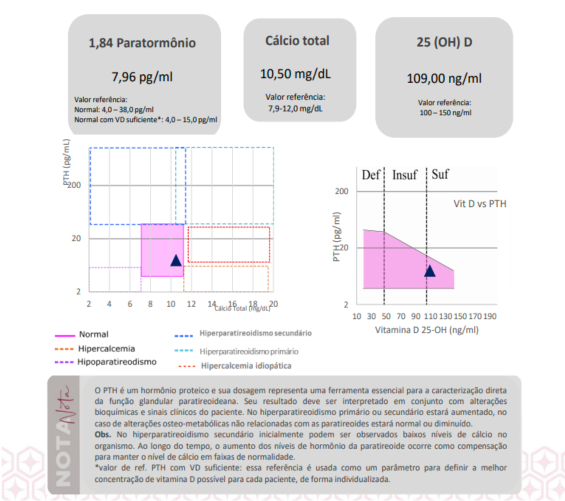
An example of an interpretive report that lists the results for PTH and total calcium, helping the veterinarian evaluate these parameters together.
This chart is not a substitute for clinical interpretation or the additional tests indicated for each patient. Its purpose is to help visualize the relationship between the parameters and to support the diagnostic reasoning process.
Do you have a patient with abnormal calcium levels?
How do I collect and submit a sample for a PTH and calcium test?
PTH and calcium tests are always performed together, with the results reported on a single order form. To ensure the reliability of the results, it is important to follow Hormonalle’s preanalytical guidelines.
The sample must be shipped frozen and contain 0.8 mL of serum. It is also important to follow the recommended fasting period and observe the guidelines for collection, storage, and transport.
To see step-by-step instructions for collection, watch the video prepared by Hormonalle.
-> Watch the step-by-step guide to proper PTH collection
To learn about other tests used to diagnose hormonal and mineral metabolism disorders in dogs and cats, visit the Hormonalle’s test catalog
References
- Hormonalle. Hormonal Guide, 2nd edition. Chapter 5.5, Calcium Disorders.
- MSD Veterinary Manual. Hypercalcemia in Dogs and Cats. Available at: https://www.msdvetmanual.com/pt/endocrine-system/as-gl%C3%A2ndulas-paratireoides-e-os-dist%C3%BArbios-da-regula%C3%A7%C3%A3o-do-c%C3%A1lcio-em-dogs-and-cats/hypercalcemia-in-dogs-and-cats
- Michigan State University, Veterinary Diagnostic Laboratory. Calcium Disorders. Available at: https://cvm.msu.edu/vdl/laboratory-sections/endocrinology/calcium-disorders-1
FAQ
Why shouldn't PTH be interpreted in isolation?
Because the same PTH concentration can correspond to different physiological responses depending on serum calcium levels. The interpretation should take into account calcium levels, the method’s reference range, and other clinical and laboratory data.
What does “inappropriately normal PTH” mean?
It is a result within the reference range that does not correspond to the expected physiological response for that situation. In the presence of confirmed hypercalcemia, for example, an unsuppressed PTH level may suggest a PTH-dependent cause, such as primary hyperparathyroidism. This finding, on its own, does not confirm the diagnosis.
What is the required sample volume for the PTH and calcium test?
The tests are always performed together. You must submit 0.8 mL of frozen serumin a red- or yellow-capped tube, without a gel separator. The recommended fasting period is 8 to 12 hours. Refer to Hormonalle’s current guidelines to ensure proper collection, storage, and transport.